Sunday, October 2, 2011

St Thomas' Church Mulgoa - Two Coincidences

On Tuesday, 13 September 2011, we visited the Mulgoa area and came upon St Thomas' Anglican Church atop the hill. This beautiful sandstone Church was conscrecrated by Bishop Broughton in 1838.

The Cox family, sons of William Cox builder of the first road over the Bue Mountains, had a strong association with St Thomas'. Edward Cox donated the five acres of elevated land on which the church was built. The sandstone used in the construction was cut from Edward's nearby property, Fernhill and from that of his brother, Henry Cox's property, Glenmore (now the Glenmore Country Club).

The graves of Edward Cox of Fernhill, died 18 May 1868 aged 63 years (photo at left) and George Cox of Wimbourne, died 20 August 1868 aged 74 years (photo at right) are found in the cemetery in the Church grounds.


In the following week, on a visit to St Andrew's Cathedral in Sydney, we came across a stained glass window which was "the Gift of George Cox of Wimborne and Edward Cox of Fernhill, Mulgoa, in memory of their father William Cox of Clarendon Richmond NSW.."


Also coincident with our visit to St Thomas', we received a request through History Services NSW for information on two convicts who it turned out were married there in 1845.

If you are researching a convict ancestor area, you should go the History Services NSW website at:

Thursday, September 29, 2011

Lapstone Zig-Zag Railway


The route of Lapstone Zig-Zag railway is now a popular walking trail. It can be accessed from Knapsack Street near the RAAF Base at Glenbrook.

As part of the construction of the first railway over the Blue
Mountains, the Zig-Zag Railway was built between 1863 and 1865 to overcome the step gradients (ranging from 1 in 30 to 1 in 33) of the Lapstone Hill.

John Whitton, Chief Engineer, originally wanted to tunnel through the hill. But due to budget constraints way back then, he designed a zig-zag (or switchback). This necessitated reversing the train, up or down, one of the three legs of the zig-zag route.

The photos, above, of the track today give a clear impression of the old zig-zag route.

Along the top points of the zig-zag are the remains of a platform. This was the Lucasville Station which was built in 1878 to service the holiday home of one, Mr John Lucas MLA, Minister for Mines. You can see the steps leading to the property but its exact location is not known.

With the completion of the Lapstone Zig-Zag and the Knapsack Viaduct, the railway line over the Blue Mountains was opened to Weatherboard (now Wentworth Falls) on 13 July 1867.

While this section of the Lapstone line was not to remain the permanent route as time passed, its construction was a significant achievement for John Whitton and his team.

Both Mary and myself have enjoyed the work of putting together the blogs on John Whitton and the Lapstone Hill. It s has taken much research, a few car journeys and lots of walking to piece the story together.

History Services NSW in its Government Contracts and Contractors database has many entries for railway contracts awarded by the NSW Government for the period 1832-1900.

Go the website at:

Tuesday, September 27, 2011

The Knapsack Viaduct


Continuing on from the from the carpark at the end of the Great Western Highway, a walkway along the old railway and highway route brings you to the spectacular Knapsack Viaduct.

The sandstone viaduct was designed by John Whitton and built over the period 1863-1864 to bridge the Knapsack Gully on the first railway route over the Blue Mountains. It was the largest viaduct in Australia being 388 feet long, 120 feet high with five spans of 70 feet and two of 20 feet. It was hailed and a engineering feat by our colonial forebears. It was a landmark for nineteenth century travellers to the Blue Mountains and beyond.

It is a massively impressive structure especially from the gully below. Taking the path from the northern side of the viaduct, we descended below to the creek bed where we
could stand next to the sandstone arches. Then taking the stairs up on the southern flank gives further interesting angular views of the viaduct. Further along is the Knapsack Quarry from where the sandstone was obtained for the construction of the viaduct. From here you can ascend to the Elizabeth Lookout and Zig-Zag Railway.

When the railway was re-routed through the Glenbrook Gorge in 1912, the lower section of the older track including
the Knapsack Viaduct was converted into a road, the Great Western Highway. This was the main road up the Lapstone until the M4 Motorway replaced it in 1993. The viaduct was widened in 1938 by moving the stone parapets outwards and placing them on concrete cantilevered slabs.

History Services NSW in its Government Contracts and Contractors database has many entries for railway contracts awarded by the NSW Government for the period 1832-1900.

Go the website at:

Sunday, September 25, 2011

HMAS Parramatta I - the Third Part of the Jigsaw


Today we went on on the Hawkesbury River Heritage Cruise, oraganised by Hornsby Shire Council and compered by historian, Tom Richmond.

Despite the teeming rain today, this wonderful river has so many stories to divulge. As Tom put it, the Hawkesbury is a "passing parade of Australian history".

One piece of history which stood out so spectacularly today between two gushing waterfalls was the wreck of the HMAS Parramatta I opposite Milson Island, where it ran aground in 1934.

We have visited this story in a previous Blog, Bow and Stern Miles Apart - HMAS Parramatta I (15 April 2011) when we located the stern at Queens Wharf Reserve on the Parramatta River, and the bow at the Garden Island Naval Base .


From the view today then, we can envisage the bow and the stern fitting neatly back into the jigsaw of the wreck in the photo above.


*************************************************
If you are in interested in early Australian History or are researching a convict ancestor go to our website at:

Saturday, September 24, 2011

John Whitton and the Lapstone Hill


In very long grass, just off the carpark at what is now the the end of the Great Western Highway at Emu Plains, is an obelisk of blue-grey stone dedicated to the memory of John Whitton (photos above) .


John Whitton was the "Father of the New South Wales Railways" being the Engineer-in-Chief from 1857-1890.

We had previously visited this monument in
August 1985 when the Great Western Highway
was the main road route up the Lapstone Hill. There is also the remains of a Gatehouse
Cottage (photo at right) nearby. It was burnt out in the fires of 1968.


Although today the monument is in a state of disrepair, it stands as a testament to engineering skills of John Whitton, and "In Memory of the Men who worked with Whitton" and to the "Women who Cared". The latter inscription is no longer extant on the monument and comes from notes that I took in 1985.

The monument was fittingly situated at the foot of the Lapstone Hill.

John Whitton oversaw the construction of the first railway over the Blue Mountains in the 1860's and it was the Lapstone incline that proved to be the first major obstacle. To overcome this Whitton designed the Knapsack Viaduct and the Lapstone Zig_Zag Railway. [See separate Blogs].

There is a statue of John Whitton at Central Railway in Sydney (Photo at right).

History Services NSW in its Government Contracts and Contractors database has many entries for railway contracts awarded by the NSW Government for the period 1832-1900.

Go the website at:

Tuesday, August 16, 2011

Convict Bricks

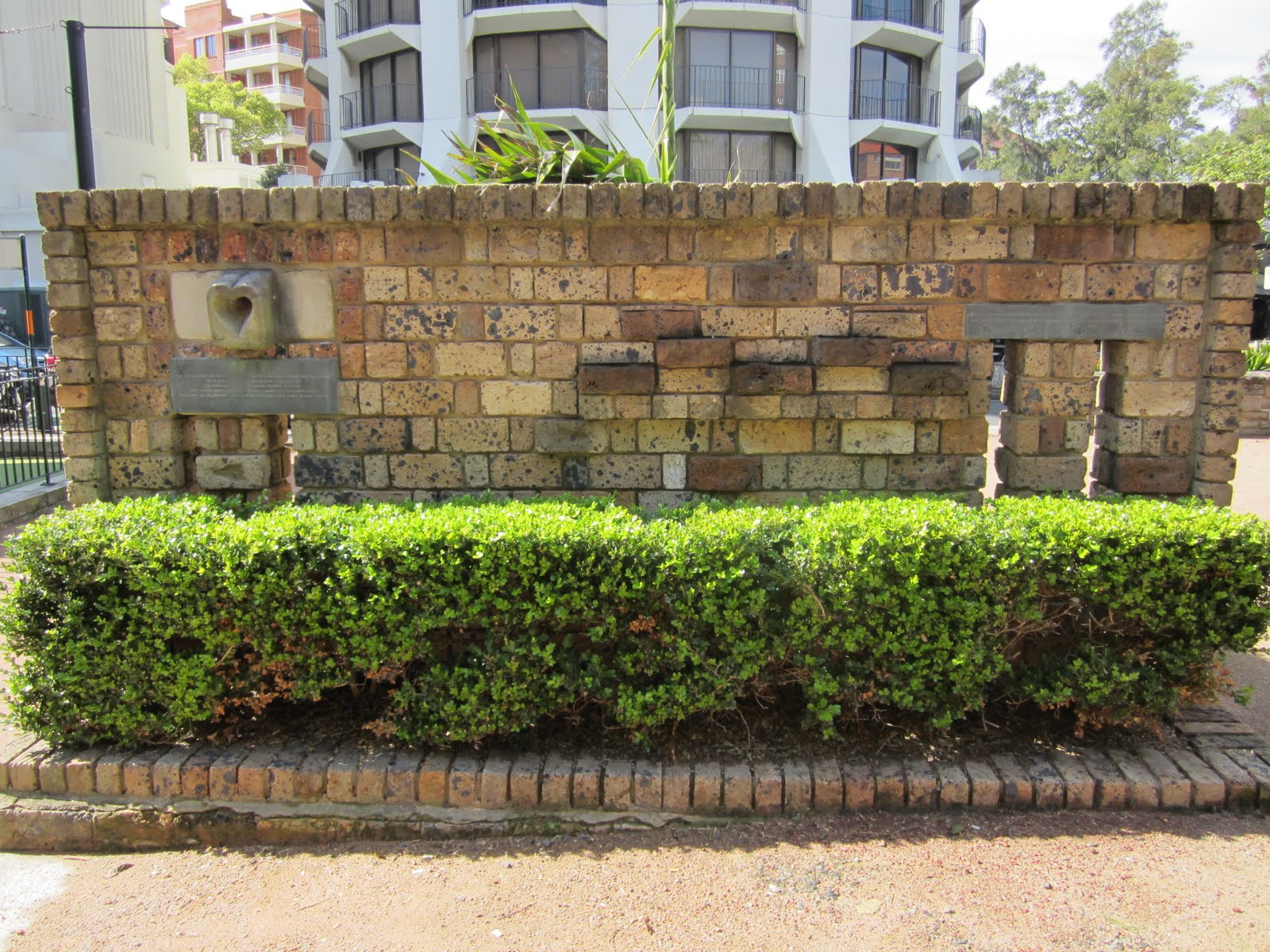
Yesterday, as part of our current project on early Sydney monuments, we visited the Kings Cross area. We discovered an interesting sandstone wall (in photo above) in a little park just near the El Alamein fountain.

It included a carved stone which was recovered in 1969 from the landscaped gardens of Elizabeth Bay House (built by the Hon Alexander Macleay, Second Colonial Secretary, on a 54 acre land grant given to him in 1828 at Elizabeth Bay).

The wall was also made up of some sandstone bricks from the early days of the Colony. Several of them contained interesting imprints, such as hearts, diamonds and animal footprints (as in the photo at right)


This put us in mind of a similar wall in the Sydney Fernery in the Royal Botanic Gardens (photo at left below). The sandstone used used in this wall is believed to have been quarried locally around 1826 when it was used for the construction of the Governor's Bath House at Farm Cove. Many of the stone blocks have "banker's marks" (photo at right below). These marks identify the convict mason's work for payment. The marks were usually made in the visible face, rather that in the bedding face, in convict brick work prior to 1850's.


If you are interested in Australian history or are researching a convict ancestor, go to our web site at: http://www.historyservices.com.au/

Tuesday, June 14, 2011

Captain Phillip's Farm

We had seen and photographed the majestic statue of Captain Arthur Phillip, first Governor of the Colony of New South Wales and Commander of the First Fleet, many times. It is located just inside the Macquarie Street entrance to the Royal Botanic Gardens.

But on a recent visit we came upon another very interesting memorial to Captain Phillip just nearby. Unveiled in January 1988, it a wall (as pictured above) made up of bricks from the 17th century house at Vernals Farm in Lyndhurst, Hampshire UK, where Phillip lived from 1763 to 1774. The bricks were dismantled from the remains of the house and reconstructed here in English Bond, bedded in lime mortar. It was a Bicentennial gift from Mr Geoffrey L Cottee to the people of Sydney.

Also planted nearby is an oak tree grown from an acorn from an ancient tree in the original garden of Vernals Farm. This is a living link with Arthur Phillip set now against the backdrop of the Sydney skyline.

Is is such discoveries such as these that bring the heroes of early Australian history to life.

It was while he was retired on half-pay from the Roayl Navy in 1763, after active service in the Seven Years Wars, that Phillip acquired the properties of Veranls Farm and Glasshayes at Lyndhurst. It was here that he married his first wife, Margaret Denison, on 19 July 1763 and settled.

So along with his naval and administrative experience that he brought to the Colony of New South Wales, Captain Phillip was also a farmer. This undoubtedly assisted his efforts in securing a food supply for new Colony under what were very difficult conditions.

Phillip went on may expeditions around the Sydney area looking for suitable land to farm. The area around Parramatta, which Phillip had named Rose Hill, was very favourable with its good soil, ready accessibility and proximity to water.

By the time , Governor Phillip left the Colony in December 1792, some 1017 acres were under crop on the public domain and important advances had been made towards attaining self-sufficiency in grain.

If you are in interested in early Australian History or are researching a convict ancestor go to our website at: http://www.historyservices.com.au/