Thursday, August 22, 2013

Rouse Hill House and Farm - A True Heritage

Rouse Hill House

Rouse Hill House and Farm at Rouse Hill in western Sydney, is managed by Sydney Living Museums under the Historic Houses Trust of NSW

It is indeed a living museum taking us back to the early days of the colony of New South Wales, and telling us the story of six generations of the Rouse family who continuously lived there from its beginnings in 1813 to 1990s.

It is rich in both colonial and convict heritage.

The actual site is the traditional lands of the Darug aboriginal people. After the founding of the colony, it saw the passage of the Hawkesbury Road (1794-1813) and later Governor Macquarie's original Windsor turnpike road of 1813. It was also the scene of the 1804 Viengar Hill convict uprising.


View of Old Windsor (turnpike) Road looking west from
Second Ponds Creek, near the site of the 1813 tollhouse.

View of Old Windsor Road looking west towards
the school house near the site of the vinegar Hill
1804 convict uprising.

Richard Rouse was the Superintendent of Public Works and Convicts. Appointed in 1805, he moved with his family to a house opposite the gates of Government House at Parramatta. Due to his loyalty to Governor William Bligh he lost his position, but in January 1810 he was reinstated by Governor Lachlan Macquarie. He oversaw the construction of many buildings, tollhouses and turnpikes around Parramatta, Windsor and Liverpool.

In 1813, Rouse was contracted by Governor Macquarie to build a tollhouse at the foot of Vinegar Hill on the Windsor turnpike road. He received a 450 acre land grant in the vicinity which at the suggestion of Macquarie was named Rouse Hill.

Although the actual grant was not made official until 8 October 1816, it appears that Rouse had been clearing the land from 1813 and had begun construction of the construction of a Georgian style house.

Convict labour would have been used extensively in the construction of the house and the farm outbuildings, including the stables.   

The House

Front view of Rouse Hill House
Open Day 17 August 2013

Dining Room


Inside Stairs


Exposed area of floor of upper storey showing the work
of convict carpenters

Back Courtyard

View of the back of the House
showing entry to the courtyard area

View of the Summerhouse and pathway

The Farm Outbuildings


Bathhouse  1856

Shearing shed

Piggery

Dairy

Impressive Stables building

Stonework outside of Stables

Inside view of stalls

An interesting early "No smoking allowed " sign


The Convict Database of History Services NSW has records for 31 convicts that were specifically assigned to Richard Rouse at Rouse Hill, upon their arrival in the Colony. The list is as follows:

SURNAME GIVEN NAME TRANSPORT SHIP DATE OF ARRIVAL
BOYLE John Bussorah Merchant 14/12/1831
BULLOCK Benjamin Waterloo 9/7/1829
COMPSON James Staffordshire 16/11/1832
DOOLAN Patrick Bussorah Merchant 14/12/1831
FARRELL James Sophia 17/1/1829
FARRELLY Thomas Calcutta 5/8/1837
FORDE John Borodino 12/7/1828
FRESHWATER Thomas Manlius 11/8/1827
HARROW Michael Larkins 22/11/1817
HEALY Timothy Borodino 12/7/1828
HEWITT Patrick Borodino 12/7/1828
HITCH John Norfolk 12/2/1837
HOLT Samuel Florentia 3/1/1828
M'GLINAHY 
[M'GLINCHY]
 [M'CLINCHY] Daniel Sophia 17/1/1829
M'GRATH Owen Ferguson 26/3/1829
M'NALLY Daniel Sophia 17/1/1829
NICHOLS William Sesostris 21/3/1826
ODGERS Edward Sophia 17/1/1829
ORPHAN 
[OLIPHANT] Edwin Parmelia 16/11/1832
PAGE Edmund Surrey 26/11/1831
PEACHMAN John Florentia 15/12/1830
REEBUCK 
[ROEBUCK] William Parmelia 16/11/1832
REED Thomas Surrey 26/11/1831
RINGROSE George Marquis of Huntley 21/8/1830
ROBERTSON James America 18/8/1829
ROBINSON Benjamin Manlius 11/8/1827
ROBINSON William Asia 13/2/1832
ROTHWELL James Florentia 15/12/1830
WARREN William Vittoria 17/1/1829
WOODISON Thomas Marquis of Hastings 31/7/1827

In his capacity as Superintendent of Convicts at Parramatta and the owner of a  a property at Bathurst, History Services NSW has some further 230 records of convicts who had come under the jurisdiction of Richard Rouse.

If you are interested in researching the convict history of the Rouse story, in particular that of Rouse Hill, you should go to the website at:

**************************************************************************************
Prepared by Mary McGuinness

All photos taken on the Open Day at Rouse Hill House and Farm on 17 August 2013

Sources:
Richard Rouse (1774-1852) - Australian Dictionary of Biography, Volume 2 (MUP) 1967 - article by Majorie Lenehan.

Convict Database  of History Services NSW

Thursday, June 20, 2013

A Rare Piece Of Convict History

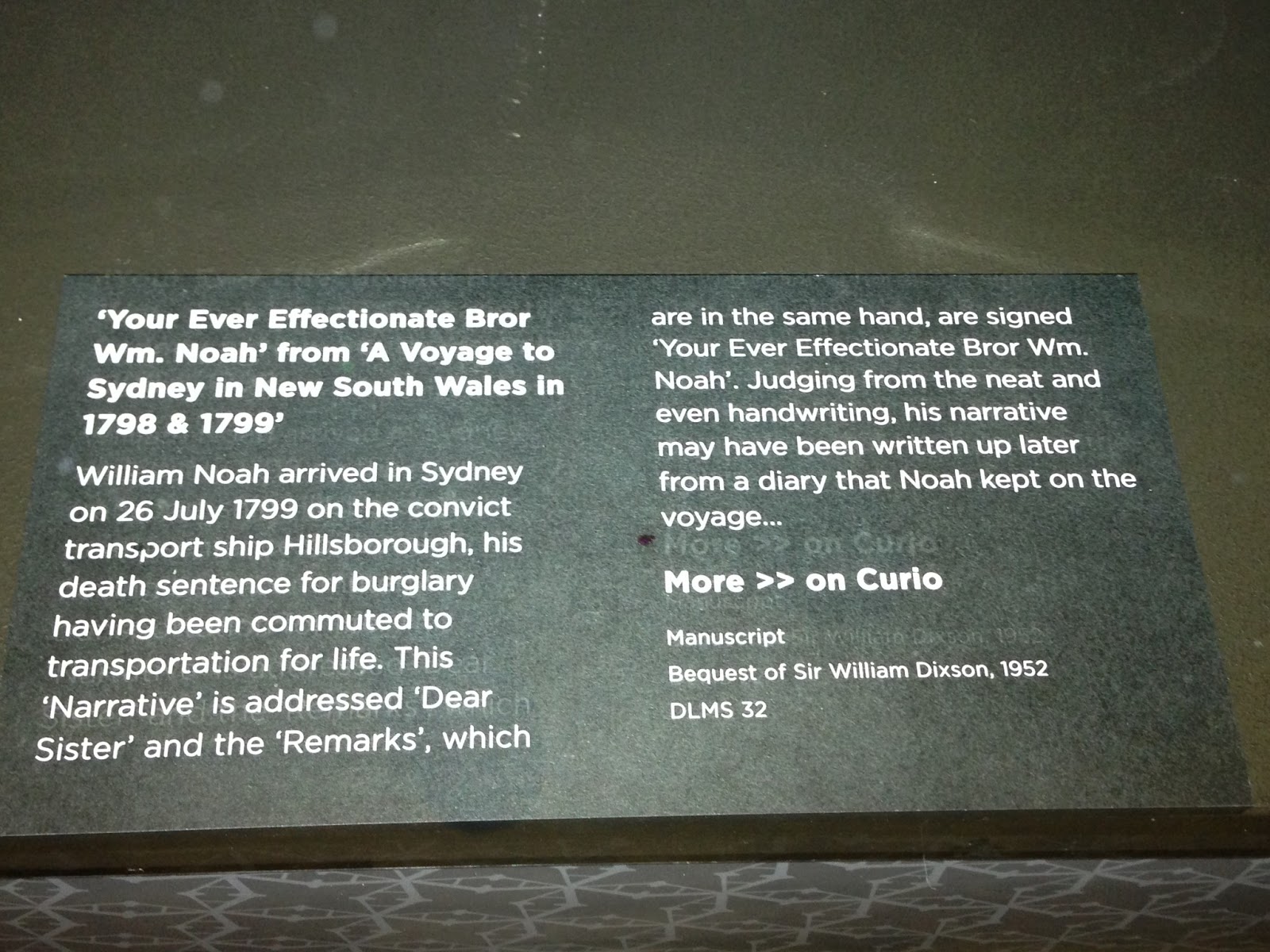
Handwritten manuscript of the convict William Noah on display at the State
Library of New South Wales - June 2013

Details about the manuscript above, State Library of New South Wales  -
June 2013

Currently on display in the State Library of New South Wales is a rare piece of convict history. It is a manuscript written by the convict William Noah about "A Voyage to Sydney in New South Wales in 1798 & 1799."

It is part of the AMAZE:The Michael Crouch Gallery exhibition which features 60 rare and quirky items from the collection of Sir William Dixson who was a major benefactor to the State Library. The exhibition celebrates Sir William's major contribution to understanding of the history of Australia, and commemorates the 60th Anniversary of his very generous bequest to the Library on his death in 1952.  

The manuscript of William Noah is a real gem in that is a poignant account of his experiences as a convict transported to New South Wales, and it is in his own handwriting. It is a real piece of early Australian history.

Details of Noah's story can be found can be found on the gallery's Curio website at: http://replay.slnsw.artpro.net.au/exhibit/429/ 

History Services NSW  also has detailed records of William Noah's life in Australia from his arrival at Port Jackson on the Hillsborough on 27 July 1799; his assignment in 1800 to Mr Palmer, Sydney; a Conditional Pardon in 1815; an Absolute Pardon in 1818; his work in the government lumbar yard; and in 1825 being designated as a housekeeper, Sydney.

If you would like further information on William Noah, or if you are researching a convict ancestor  go to our website at :

*****************************************
Blog prepared by Mary McGuinness

All photos taken June 2013


Thursday, May 2, 2013

Visiting Bar Island

Approaching Bar Island from Berowra Creek
On Tuesday, 30 April 2013,  we visited Bar Island in Broken Bay as part of the bushwalks program of Hornsby Shire Council.

Bar Island  is situated at the mouth of Berowra Creek as it flows into the Hawkesbury River. It is only a small island covering some 3.8 hectacres in area and is located approximately five kilometres west of the Mooney Mooney Bridge. It is uninhabited today but is rich in Aboriginal and European history.


New signage
It was traditionally part of the land of the Dharug and Darkinjung Aboriginal people. An Aboriginal shell midden is found next to the wharf on the island.

Aboriginal shell midden near wharf.

Governor Arthur Phillip is reported to have have visited Bar Island on his second exploration visit to the Hawkesbury area in June 1789.

In the 1870s, Bar Island became a focal point for the local communities of the Hawkesbury with the coming of St John's Church of England, a school and a cemetery.

The Church was built in 1876 by John Crumpton, opening on 20th October that year with services being conducted by Rev Henry Ham Britten. A' half-time' school (in conjunction with the Peats Ferry School) was established on the island in 1875. Classes were held in the church from the following year. A violent storm in 1887 badly damaged the weatherboard church and it was demolished in 1892.

The only remaining part today is the stone fireplace and chimney which had been incorporated into the building using stone from George Peat's home "Fairview" which had fallen into ruin at nearby Mooney Mooney.

Fireplace and chimney remains of St Johns Church of England


Back view of fireplace facing the sun

But it is in the cemetery where we find a testament to the history of the early pioneers of the Hawkesbury district. A list of the known burials in the Bar Island cemetery is given at the foot of the Blog.

View of Cemetery looking up the hill
In 2007, Hornsby Council with funding from the NSW Department of Planning, repaired broken headstones such as those below:

Grave of Robert Milson died 14 September 1886
aged 62 years
Grave of Ann Elizabeth Milson, his wife,
died 9 September 1886
aged 39 years
Grave of Charles F Brown
Master Mariner
died 21 March 1901
aged 41 years

Grave of Harriet Young
died 14 December 1884
aged 75 years

Grave Alexander Bow Wilson
died 3 May 1887
aged 33 Years

Grave of James Cole
Native of Bristol England
died 26 February 1885
aged 71 Years

Grave of Mary Greer, died 18 July 1885
aged 65 year, and her husband,
John Greer, died 30 March 1888 aged 66 years
Grave of Charlotte Burton died 23 July 1890 aged 75 years, and
Marianne Bowles died 26 October 1892 aged 41 years.


Grave of Francis Byrne died 4 May 1887 aged 6 years.

Grave of Cyril Joseph Rose
 
 died 22 November 1895
aged 2 years and 6 months
The stories behind the people buried on Bar Island are truly fascinating. From unmarked graves, three tales emerge:
  • Sarah Lewis Ferdinand who was an Aboriginal woman who married  a German convict, John Ferdinand Lewis. They lived at Marramarra Creek and had seven children. She was known as Biddy and later Granny Lewis as she became the matriarch of a large group of Aboriginal and local pioneers. She died in 1880 and is buried on Bar Island. This is particularly significant as the locations of burial places of tribal aborigines are not widely known. 
  • James Calvert whom we identified as a convict. History Services NSW records that James arrived on the ship John in Port Jackson on 25 November 1827 from London. On arrival in the Colony, he was assigned as a labourer to Joseph Foulks of Lower Portland. He received a Ticket of Leave in March 1836 at Mangrove Creek, and a Conditional Pardon on 1 October 1842. In 1855, he married Ann (Annie) Jones at the Church of England  at Kincumber .He died at Brisbane Water in 1880 and is buried with his wife who died in 1883, in the Bar Island Cemetery.  
         ****************************************************************************


Known Burials in the Bar Island Cemetery, Hawkesbury River

Mary Ann Absolem                    Rubina Cole                              Maude Lloyd    
1822 - 1887                               Died 1880, aged 17 days           Died 1880, aged 3 weeks

Caroline Mary Banks                 Sarah Ferdinand                        Richard Lloyd
Died 1879, 
aged 5 months         Circa 1803 - 1880                      1830 - 1894

Marianne Bowles                       James W. Garthon                    Unnamed male child Lyden
1851 - 1892                              1859 - 1898                               Died 1884, aged 1 hour

William John Bowles                  Betsy Goodridge                       Frederick A. McLaughlin
1849 - 1903                               1856 - 1894                              Died 1903, aged 8 months

Charles Frederick Brown             Eva Isabella Green                    Ann Elizabeth Milson
1860 - 1901                               1901 - 1904                              1847 - 1886

Charlotte Burton                        James Kenneth Green                Cyril Joseph Rose
1815 - 1890                               Died 1904, aged 7 months         1893 - 1895

Annie Ellis Butters                     Mary Ann Jane Green                Elizabeth Bessie Rose
1839 - 1898                               1877 - 1897                              1824 - 1897

Joseph Blundell                         William Henry Green                  Mary Elizabeth Scott
Died 1906, aged 2 weeks           1874 - 1906                               Died 1887, aged 6 weeks,
 

Albert Byrnes                            John Greer                                Vincent William Seymour
Died 1898, aged 17 days           1822 - 1888                               1824 - 1899

Francis J. Byrnes                      Mary Greer                                Ivy Sutton
1881 - 1887                              1821 - 1886                               1900 - 1901

Joseph Byrnes                          Richard Hibbs                           Lavinia Blanche Thompson
1836 - 1882                              1844 - 1904                               Died 1884, aged 3 months

Maria Byrnes                             Samuel Albert Holland               Frederick H. Underwood
1843 - 1901                               Died 1899, age unknown            1854 - 1902

Annie Calvert                             James Augustus Jessup            Mary Whitley
1816 - 1883                               1840 - 1902                              1847 - 1885

James Calvert                            Ruby Johnson                           Alexander Bow Wilson
1805 - 1880                               Died 1887, aged 11 months       1854 - 1887


James Cole                               Sarah Emily Johnson                 Harriett Young
1814 - 1885                               1859 - 1895                              1810 - 1884

Mary Cole                                 Mary Annie Jones
1820 - 1892                              1853 - 1883


************************************************************************
Blog prepared by Mary McGuinness

All photos taken April 2013

Reference sources:
Lorna Olliff:; There Must Be a River - A History of the Hornsby Shire, Ollif Publishing Co Sydney, 1975.

Tom Richmond: Hawkesbury River Heritage Cruise, September 2011

If you are interested in researching Australian history, go to our website at :
http://www.historyservices.com.au/


Monday, April 1, 2013

Sydney Tram Memories

With the proposed return of trams to the streets of Sydney (Sydney's Light Rail Future - December 2012), it is interesting to see reminders of our previous tramway history at various locations throughout Sydney. These include:

1. Several ornate tram shelters which are still standing, including the one at Balmoral Beach and another on Elizabeth Street, Sydney opposite the Great Synagogue.  

Tram shelter at Balmoral Beach - May 2012
  
Tram Shelter, Elizabeth St, Sydney - March 2013

2.  Ornamental rosettes located on many older buildings and rock faces where overhead wiring span wires for the trams were attached. 

Two rosettes on a building in George Street, Sydney - September 2012

Rosette on the David Jones Building a the corner of Castlereagh and
 Market Sts, Sydney - September 2012. 
Note the rounded front on the David Jones (Market Street) building. Many street corners were 'cut-back' to allow space for trams to turn. Many of the building on such corners still have rounded fronts.


Rosette on the rock face in Lawry Plunkett Reservce at Balmoral, on the route
of the  Balmoral tramline - May 2012
There are seven rosettes on the rock face near the Sydney Opera House at the site of what was the Fort Macquarie Depot.

Two of the rosettes on the rock face near the Sydney Opera House -
March 2013
View of the rock face near Sydney Opera House
 at the site of the Fort Macquarie Tram Depot - March 2013
3) Tram  tracks on Glebe Point Road at Glebe. A small section of the original tram tracks were uncovered by roadworks in 2009. The City of Sydney Council left them exposed as a historical reminder.


Tram tracks in Glebe Point Road at Glebe - 8 May 2012
4) The tunnel portals for the tram tracks running across the Sydney Harbour Bridge to the underground tram terminus at Wynyard Railway Station. These can been seen from the pedestrian walkway on the eastern side of the Bridge.        

Tunnel Portals to Wynyard from the Sydney Harbour Bridge - May 2011

5) Site of McMahons Point Electric Tram Terminus 1909 - 1932. The double track along Blues Point Road formed a loop here by the Ferry Wharf providing an extra link with the city from the North Shore Suburbs. The line was not needed after the opening of the Sydney Harbour Bridge in 1932.

Site of McMahons Point Tram Terminus - May 2012


Tram monument at McMahons Point Wharf (mid right of photo) - May 2012, 

6) Two monuments commemorating the extension of the tramway from Drummoyne to Ryde in 1910. The first which is now located at the rear of the Ryde Civic Centre was unveiled in December 1908 to mark the 'turning of the first sod' for the extension of the tramway from Drummoyne to Ryde. The actual terminus for the line was located near the intersection of Pope and Devlin Streets adjacent to the current Top Ryde Shopping Centre. 

Ryde Tramway Monument located at the rear of the Ryde Civic Centre in
 Devlin Street - August 2012

Inscription on Ryde Tramway Monument - August 2012
The second is the Sutton Memorial Tramway Monument in Ryde Road at Monash Park. This was unveiled to commemorate the opening of the new tramway on 11 June 1910, and in memory of Joseph Sutton, son of Ryde Alderman Rowland Sutton. It was originally erected at the intersection of Wharf and Victoria Roads at Gladesville.


Sutton Memorial Tramway Monument, Ryde Road ,
Monash Park - August 2012

7) Rozelle Tram Depot at Glebe which was the second largest tram depot on the Sydney network from 1904 until its closure in 1958. Today is it part of the Harold Park development by the Mirvac group. The heritage listed sheds which are on the northern edge of Harold Park will form the retail heart of the complex. 


Site of the Rozelle Tram Depot.
Heritage listed sheds in the background - May 2012
                    ********************************************************************************


Tram Memorial Plaque in Devonshire Street Tunnel, Central Railway
- May 2011
Trams first ran in Sydney in 1867. 

History Services NSW in its Government Contracts and Contractors Database has over three hundred records relating to granting of NSW Government contracts for the Sydney tram network from that period to 1900 when most of the metropolitan network was built.

If you are interested in further information go to our website at :
http://www.historyservices.com.au/

All photos taken 2011-2013.

Blog prepared by Mary McGuinness


Thursday, March 7, 2013

Crossing the Blue Mountains - The Starting Point

With the bi-centenary of the first crossing of the Blue Mountains by Europeans in 1813 coming up in May 2013, there will be many celebrations and re-enactments. Interesting details of theexpedition will emerge.

Warren Brown, editorial newspaper cartoonist for Sydney's Daily Telegraph, is currently retracing the route of the explorers Gregory Blaxland, William Charles Wentworth and William Lawson. He wanted to begin at their exact starting point on Gregory Blaxland's farm near South Creek [Daily Telegraph, 5 March 2013].

We had previously located a memorial cairn to the three explorers in Luddenham Road at Orchard Hills adjacent to the former site of Blaxland's farm "Leeholme". It was erected in 1938 and marks the staring point of the Blaxland, Lawson and Wentworth expedition on 11 May 1813. 

Explorers Memorial Cairn on Luddenham Road , Orchard Hill
 Photo taken September 2011

"Here on the South Creek
 was Gregory Blaxland's farm
From it on May 11, 1813
he set out with
William Lawson and WC Wentworth
attended by four servants
with four pack horses and five dogs
on the first expedition
that crossed the Blue Mountains .

-----------------------
Citizens of St Marys 1938

Official records of the expedition, including the diaries of the explorers make no mention of the names of the 'four servants' that accompanied them.

History Services NSW has records, sourced from State Records, for five convicts who were remunerated for their services in crossing the Blue Mountains. These convicts were:
James Byrne per Anne, arriving in Port Jackson on 21 February 1801 from Cork, Ireland, who was:
  • paid from Police Fund for services as a guide to the party who crossed the Blue Mountains, document dated 5 February 1814 [State Records reel 6038 page 456, SZ758];
  • paid from Police Fund for services in making discoveries west of the Blue Mountains, document dated 30 April 1814 [State Records reel 6038 page 489, SZ758].
  • on the list of persons who are to receive grants of land in December 1814 for crossing the Blue Mountains, document dated 12 Dec 1814 [State Records Fiche 3266 page 20, 9/2652].
John Cogan  per Tellicherry, arriving in Port Jackson on 15 February 1806 from Cork;  
Richard Lewis
per Coromandel 
arriving in Port Jackson on 13 June 1802 from Spithead; 
John Tighe (Tygue) per Anne, arriving in Port Jackson on 21 February 1801 from Cork; and, 
John Grover per Anne arriving in Port Jackson on 27 February 1810 from England;
who were all:
  • paid from Police Fund for services in making discoveries west of the Blue Mountains, document dated 30 April 1814 [State Records reel 6038 page 489, SZ758].
  • on the list of persons who are to receive grants of land in December 1814 for crossing the Blue Mountains, document dated 12 Dec 1814 [State Records Fiche 3266 page 20, 9/2652].
The earlier date of 5 February 1814 for James Byrne,as well as corroborated research, would indicate that he was part of the first expedition over the Blue Mountains.

It has been established that the other four convicts accompanied George Evans on the second journey over the Blue Mountains in November 1813 [Footsteps in Time: A Road Across the Mountains, John Yeaman 2010].

            **********************************************************************************

History Services NSW has  records of  sixty-nine convicts who took part in further expeditions of discovery with the early explorers.

If you are researching a convict ancestor, you should go to our website at: http://www.historyservices.com.au/convicts.htm


Blog prepared by Mary McGuinness

All photos taken in September 2011